Enforcing Content Quality for Translation Systems
For confidentiality, I’ve altered some details but the core design challenges, decisions, and outcomes are real.
In 2024, I was responsible for framing the vision, research, and end-to-end design of a new authoring and editorial review experience within Amazon’s translation ecosystem. I partnered closely with engineering, localization operations, and science teams to define the workflows, prototype key interactions, and align design principles across authoring, review, and AI-driven quality systems.
When Source Quality Breaks Translation
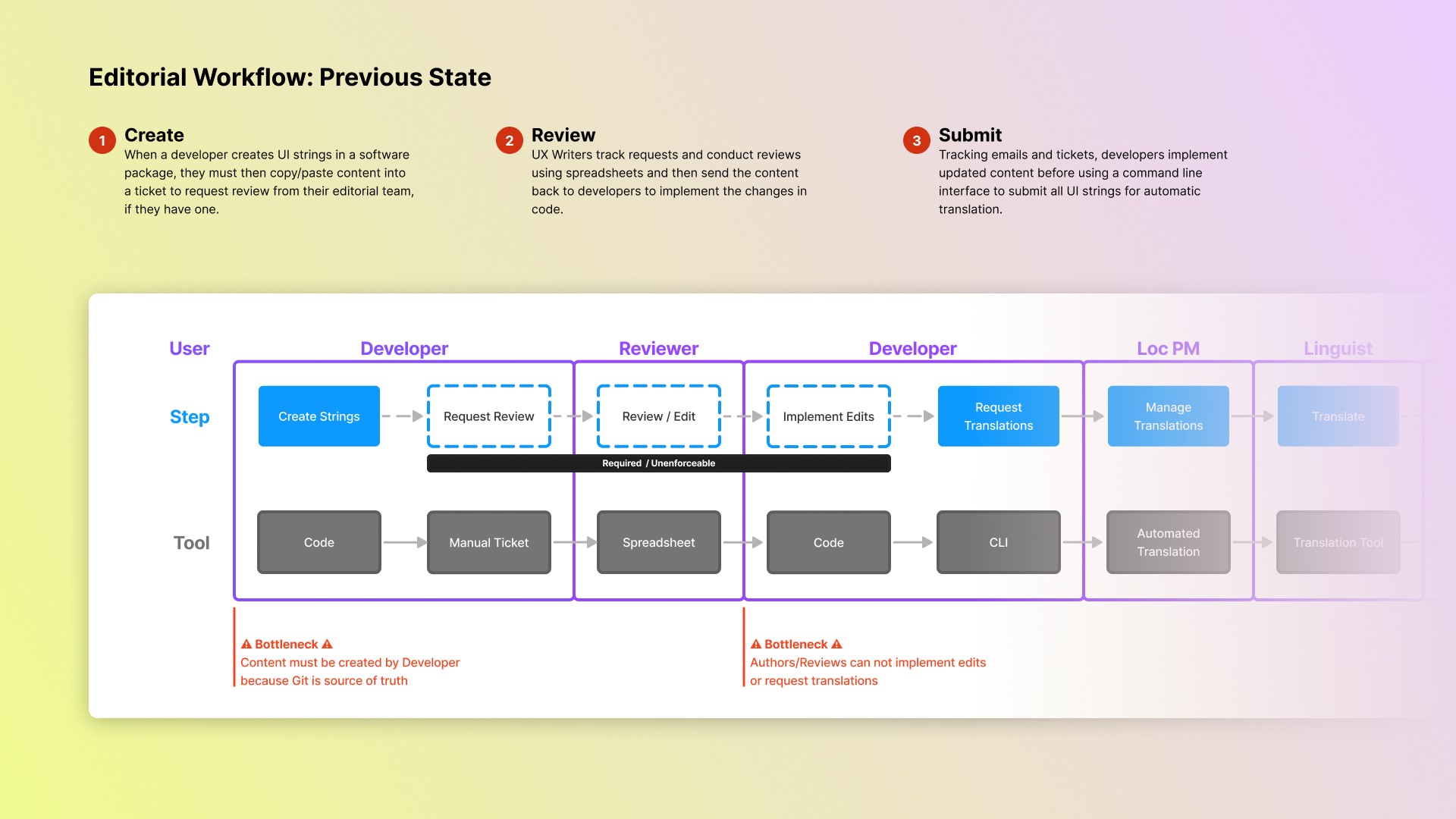
One of the leading causes of mistranslations is poor-quality source content: garbage in, garbage out. Typos, unclear phrasing, and inconsistent terminology in the original copy cascade into every target language, multiplying into confusion for customers and costly rework for translators.
At Amazon, errors were amplified across dozens of languages, millions of products, and billions of words. Fragmented authoring systems and ad-hoc review processes made it nearly impossible to maintain quality. Reviewers relied on spreadsheets and Slack threads, while 75% of smaller teams had no formal review at all.
The result: wasted cycles, duplicated work, and inconsistent global content. We needed a unified editorial review layer that enforced quality at the source, without slowing teams down.
What Reviewers Really Needed
Through research and testing across teams like Retail and Prime Video, we uncovered shared behaviors that shaped the design:
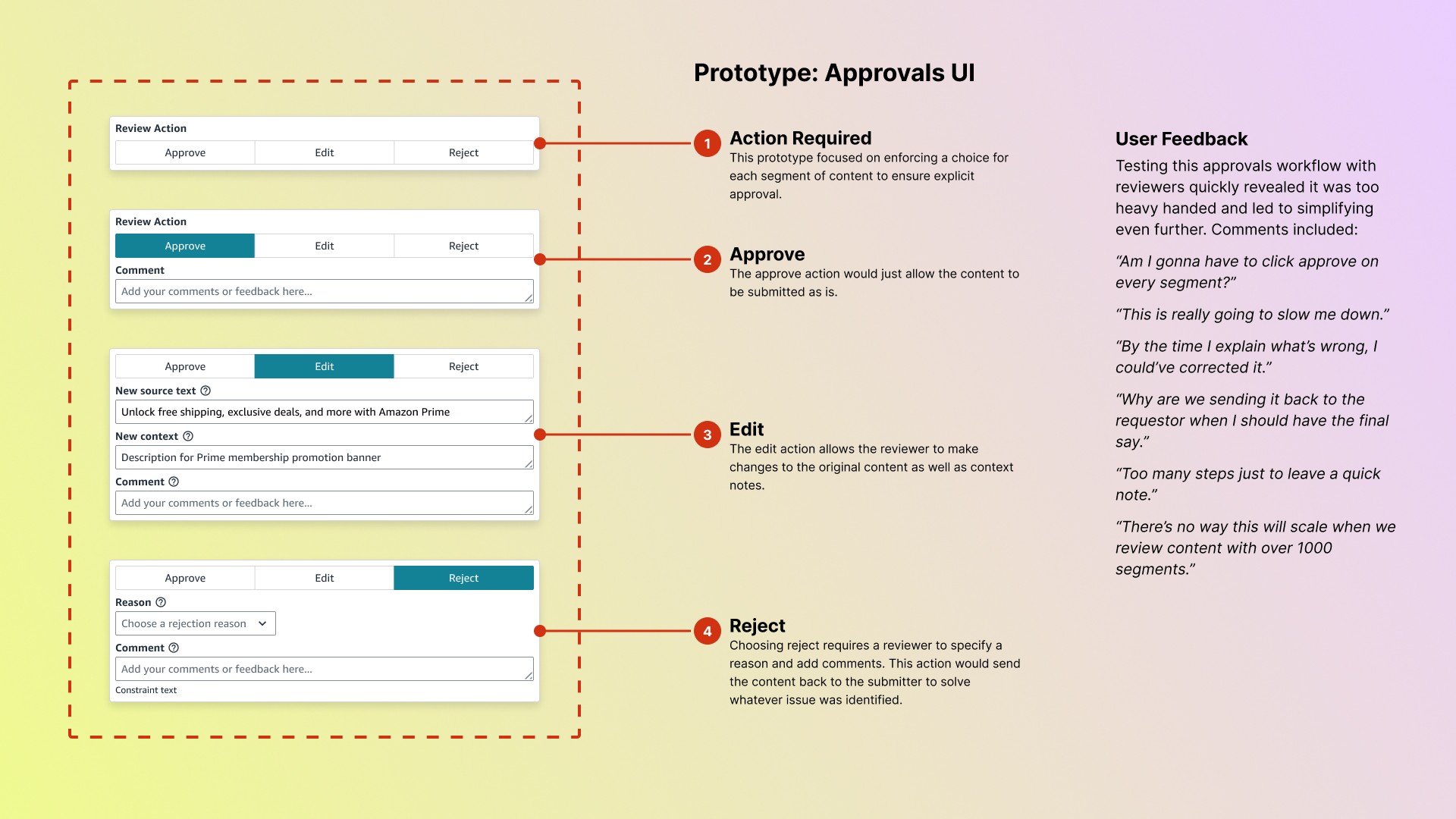
Editors worked in bursts—scanning large batches, fixing on the fly, and preferring autonomy over rigid process.
As one reviewer said, “By the time I explain it, I could’ve just fixed it.”
Meanwhile, legal teams needed audit trails and formal approvals. Treating both groups the same created friction on both sides.
The insight was clear: design lightweight, flexible workflows for editors, and separate high-governance reviews for legal.
Designing for Speed and Trust
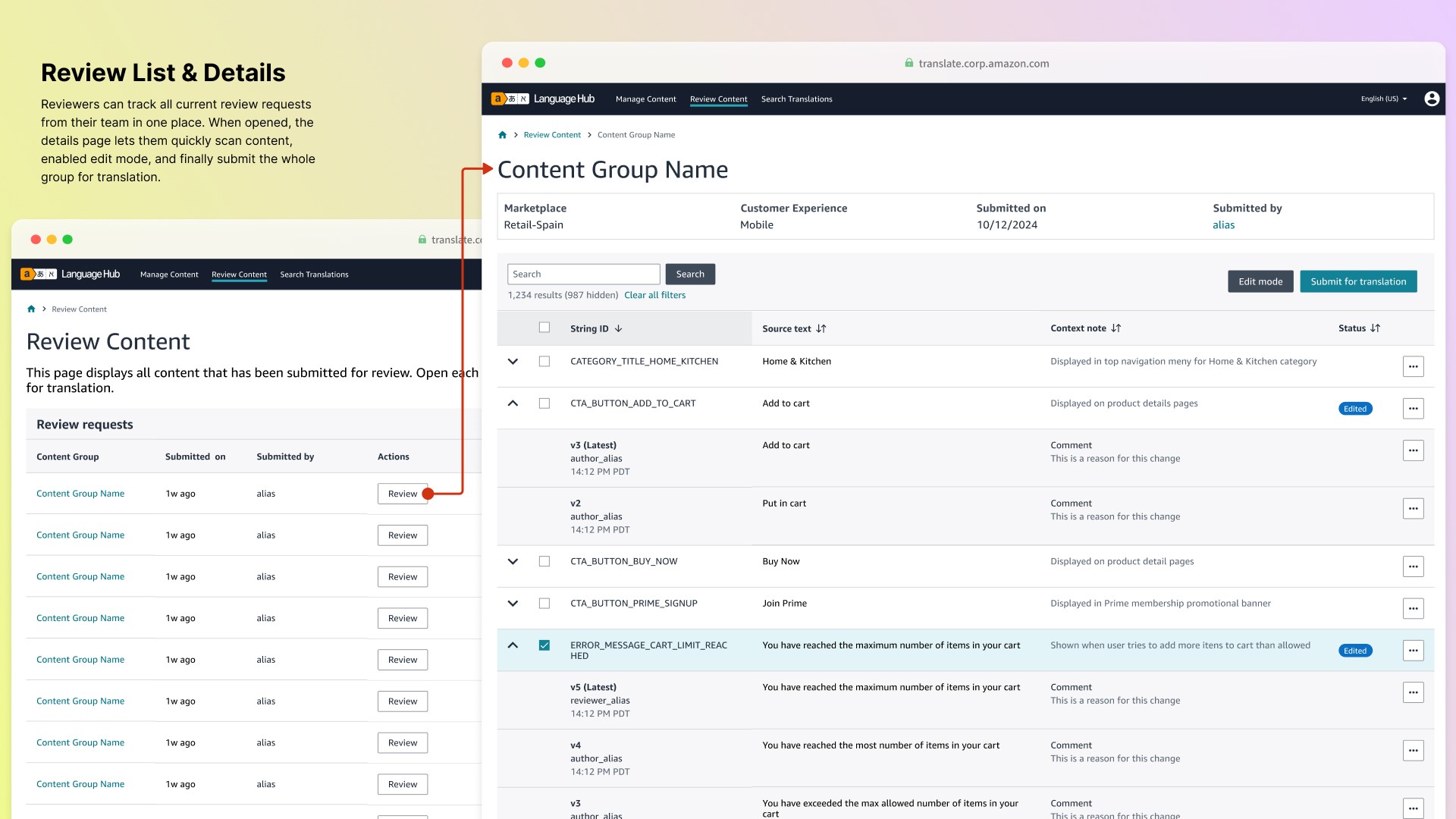
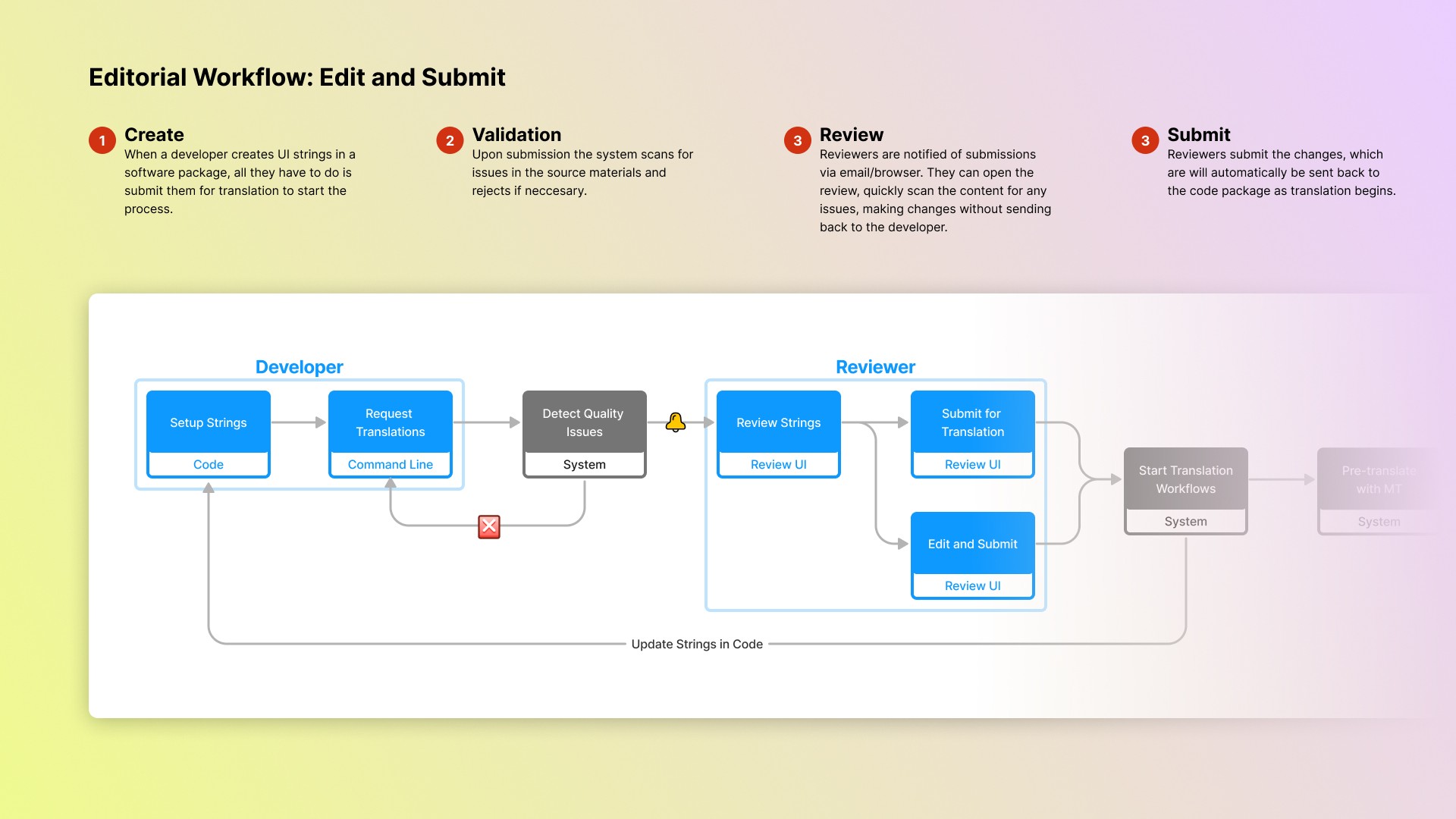
The system embedded editorial review at the start of the translation workflow, giving reviewers immediate, in-context control. Every submission entered through one entry point, ensuring visibility and traceability. Reviewers could scan, edit, and submit directly—cutting handoffs and eliminating confusion.
A simple dashboard surfaced pending content, while the editing workspace supported fast, inline correction of strings. This design balanced governance and agility—trusting editors to move fast while capturing structured data for downstream systems.
Finding the Right Editing Model
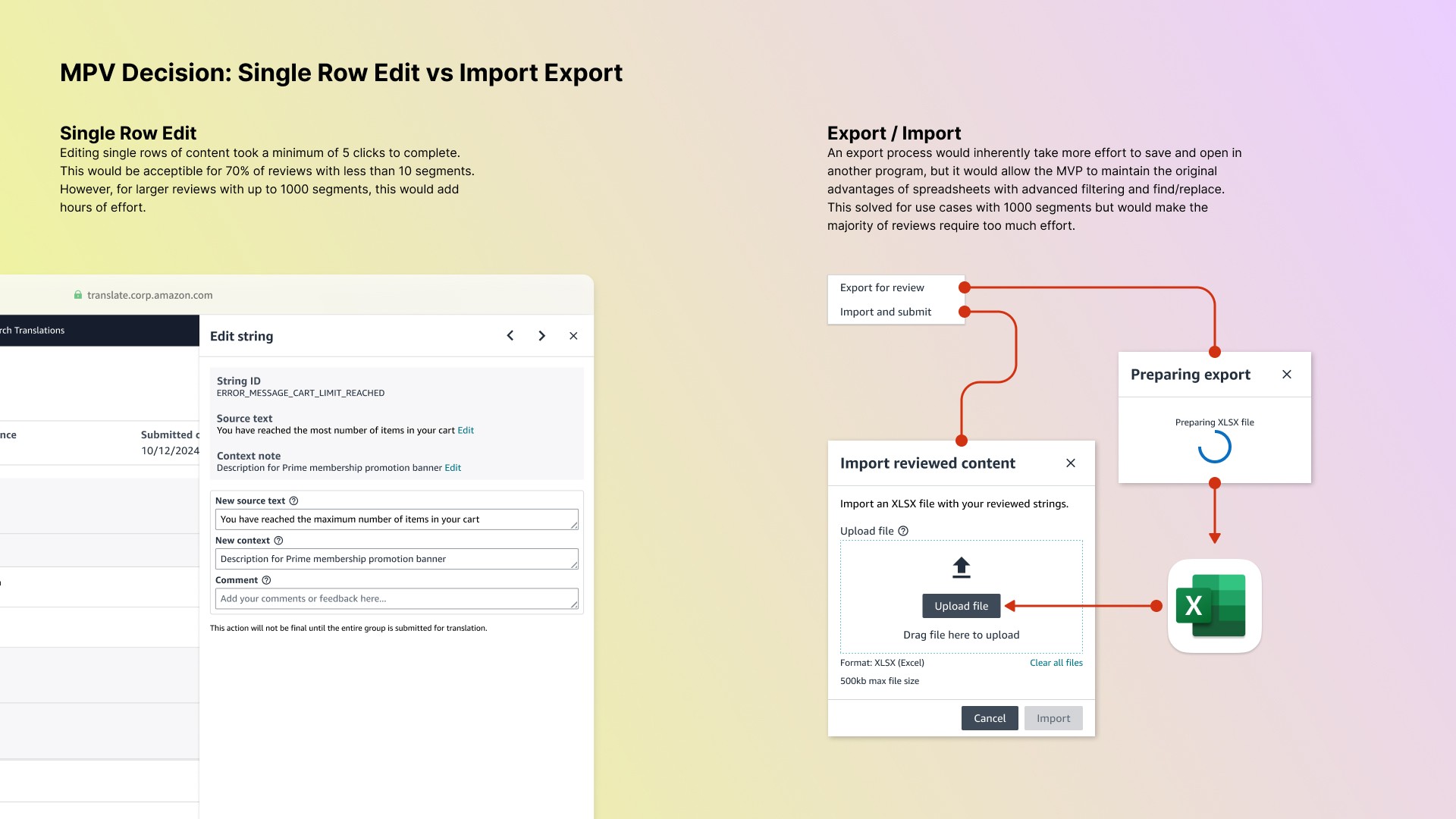
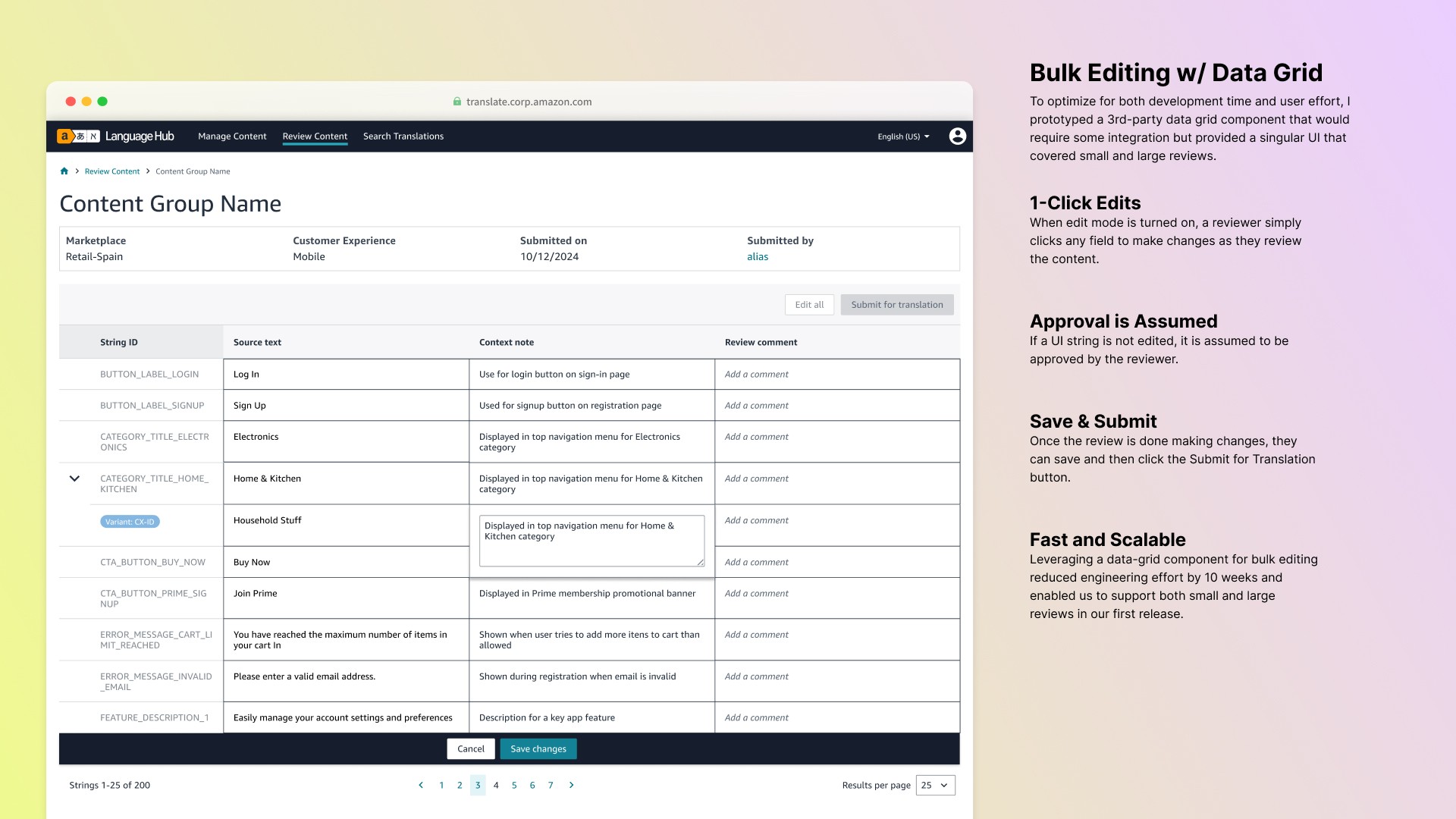
The MVP hinged on a trade-off: power vs. speed. Pop-up editors were too slow for large jobs; Exporting to Excel gave power users flexibility but added so much overhead to small jobs. After analyzing user feedback, review job sizes, and clicks-per-edit, it was clear that it would be too painful to address only one of the use cases.
The solution was to license a high-performance data grid and integrate it into our internal frameworks. This allowed direct cell-level editing, search/filtering, and easy pagination. Building an interactive prototype enabled me to align leadership and our developers on adapting the product to get immediate gains for our customers while limiting effort.
Scaling Human Feedback for AI
By encapsulating edit and review patterns within our system, it also established a new set of structured signals for quality improvement. Human fixes could now feed future automation, turning everyday editorial work into training data for translation and content quality models.
From Governance to Growth
The launch of Editorial Review enabled 7 large organizations within Amazon, including Prime Video, to onboard onto our automated translation system while gaining a new level of governance over the quality of their content.
Early adopters like Prime Video cut daily review cycles by 40%, increasing throughput without adding headcount.
Authors gained full visibility from draft to translation, reducing confusion and duplicate edits. For Amazon, that meant faster localization, more consistent messaging, and a scalable foundation for AI-driven quality feedback loops.
The Right Friction in the Right Places
What I took away most was the importance of balance. In a company this large, it’s easy to lean too far into governance, adding structure to manage risk until it starts to manage people instead.
The right solution wasn’t less oversight; it was the right kind of oversight. By matching the level of governance to the use case—adding friction where it creates clarity, and removing it where it slows momentum—we built a system grounded in trust, not control.